
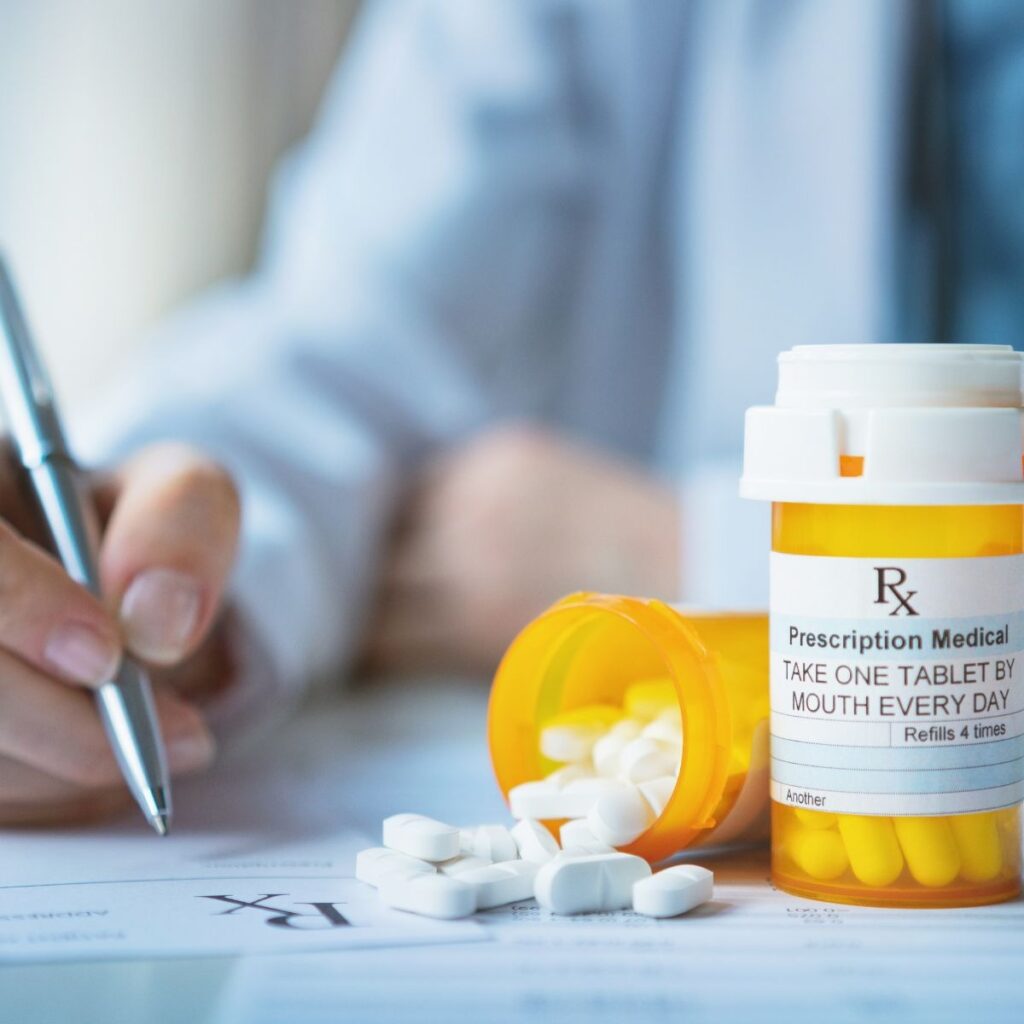
FDA–approved medications that reduce cravings and withdrawal symptoms, making it easier to work on underlying issues.

Suboxone (buprenorphine / naloxone)
Daily medication taken as a dissolvable film or tablet. Reduces cravings and prevents withdrawal from opioids. Allows you to function normally without getting high.

Sublocade (extended-release buprenorphine)
Monthly injection administered by a provider. Same medication as Suboxone but lasts 30 days. No daily medication to manage -- helpful for people who prefer less frequent dosing or have difficulty with daily medication routines.

Vivitrol (naltrexone)
Monthly injection that blocks the effects of opioids and reduces alcohol cravings. Works for both opioid and alcohol use disorders. Requires full detox before starting: you must be substance-free for 7-10 days.
How does MAT work?
MAT medications work on the same brain receptors affected by opioids or alcohol, but in a controlled, therapeutic way. They stabilize your system so you can function normally while working on behavioral changes.
Is MAT just replacing one drug with another?
No. MAT medications are prescribed at stable therapeutic doses that don't produce euphoria or impairment. They allow normal function: going to work, caring for family, driving safely. The goal is stability and recovery, not getting high.
How long will I be on medication?
It varies. Some people stay on MAT for months, others for years. There's no set timeline. Treatment continues as long as it's helpful.
Do I have to do counseling to get medication?
Counseling is strongly encouraged but requirements vary. Your provider will discuss what's recommended based on your situation.
EXCELLENTTrustindex verifies that the original source of the review is Google. I adore Dr. Seeema Arora. She Is so informative and such a Wonderful health care provider. She always takes such time with me especially after loss of my husband. Having her as my primary care doctor and my Suboxone doctor is such a great thing for me. I feel so comfortable with her and her attention to my personal health care needsPosted on GoogleTrustindex verifies that the original source of the review is Google. Ive been seeing Dr. Seema Arora for over 8 years now. I wont go anywhere else and hope they never close. Highly recommend!! A++++Posted on GoogleTrustindex verifies that the original source of the review is Google. I have been a patient of Dr.Seema Arora for a long time. She has been extremely helpful in my long term sobriety. The office is great and she also is very helpful, caring, and supportive. This program has completely changed my life and im very grateful for Dr. Arora and all staffPosted on GoogleTrustindex verifies that the original source of the review is Google. I've been a patient of Dr.Seema Arora for the last 7 years. Dr. Arora has far exceeded any hopes or expectations I had for my care at lmc in Peabody, from scheduling appts to making sure follow ups go just as smooth . Her patience, compassion and understanding make it easy to talk with her, I always feel like shes listening & cares about my well being,... If there was an option for 10 stars she would have gotten 10...Posted on GoogleTrustindex verifies that the original source of the review is Google. If you or a loved one need help with substance abuse, look no further. I have been a patient with Dr. Arora for several years now, and I couldn't be happier! She is THE BEST! Dr. Arora, her receptionist Madeline, and the rest of the staff here are all very kind & understanding, and will go out of their way to help you with what you need. I'm very grateful my friend gave me her card.Posted on GoogleTrustindex verifies that the original source of the review is Google. I am writing this review to express my sincere appreciation for the exceptional care I have received at Lawrence Medical Center over the last eight years. Despite having moved an hour away, I continue to make the drive because of the incredible quality of service, particularly from Dr. Arora and Madeline Rosa. The practice has definitely evolved over the years, and I cannot say enough positive things about the atmosphere and the staff. Madeline Rosa, at the front desk, is by far the most amazing person; she keeps the practice running smoothly and genuinely cares about each and every patient. I look forward to my appointments because I know her smiling face and hilarious personality will be there to greet me! Dr. Arora is truly outstanding. She takes her time, listens attentively, and is clearly dedicated to helping her patients. She is incredibly kind, knowledgeable, empathetic, trustworthy, and personable. It is very easy to lose track of time when speaking with her because she makes conversation so effortless and genuinely wants to know how you are doing and what she can do to improve things. The team here truly treats patients like family. It will be a sad day when I eventually have to say goodbye, but I will be forever grateful knowing they were instrumental in helping me get to where I am today. Thank you, Dr. Arora and Madeline, for everything!!Posted on GoogleTrustindex verifies that the original source of the review is Google. Madeline is amazing, she goes above and beyond and takes the time to truly help each patient as if they were her family. She is truly blessed with patience , kindness, and understanding. Extremely thankful for her.Posted on GoogleTrustindex verifies that the original source of the review is Google. I’ve been a patient in Dr. Auroras care for at least 4+ years. I absolutely feel seen, heard and cared about in my care with her. I highly recommend you give her and the staff at Lawrence medical a call. She also works with people in recovery and is phenomenal!!!Posted on GoogleTrustindex verifies that the original source of the review is Google. Dr.Arora is an all around professional who genuinely cares about her patients and their wellbeing. Lawrence Medical takes the time to understand your needs and address them as quick as possible. I credit Dr. Arora and the staff for saving my life, and giving me my life back. Madeline and the front office staff will do everything they can to accommodate you as a patient and always put you first! Thank you Dr. Arora and Team!Posted on GoogleTrustindex verifies that the original source of the review is Google. A Lifeline for My Family: The Compassionate Expertise of Dr. Seema Arora Finding a doctor who truly understands the complex journey of addiction is a rare blessing—one my family and I have been incredibly fortunate to experience with Dr. Seema Arora. From our very first meeting, she radiated warmth and genuine empathy, making us feel seen and heard in a way that goes far beyond the typical clinical visit. Her attentive listening and nonjudgmental approach created a safe haven, not just for me, but for every member of my family who has walked this path with me. Dr. Seema Arora’s professionalism is second to none. She masterfully blends deep expertise with unfailing compassion. Whether offering sound medical advice or a reassuring word on a tough day, she is always a calm, steady presence I know I can rely on. It is clear that she is fiercely dedicated to her patients’ well-being, never hesitating to go the extra mile to ensure that both the individual struggling with addiction and their loved ones find hope, guidance, and support. If you, or someone you love, are looking for a specialist who genuinely cares and is fully committed to helping people reclaim their lives, Dr. Seema Arora is that rare professional you can trust. No matter how tough the journey, with her by your side, you can be confident that you are in the very best hands.Showing our latest reviews

Counseling and recovery support
Medication addresses cravings and withdrawal. Counseling addresses the patterns, triggers, and underlying issues.
Individual counseling
One:on:one sessions to understand your patterns, identify triggers, develop strategies for difficult situations, and address underlying concerns like trauma or mental health.
Group counseling
Structured sessions where you connect with others working on similar goals. Share experiences, learn from each other, build practical skills. Facilitated by trained providers.
Case management
Help navigating insurance, accessing community resources, coordinating care, and removing barriers that make recovery harder.
Peer recovery support
Guidance from people with lived experience who understand what you’re going through.
Medical support during withdrawal
If you're ready to stop using, medical supervision can make the process safer and more manageable.
We provide outpatient withdrawal management: regular check:ins with a provider who monitors symptoms and may prescribe medications to reduce discomfort as your body adjusts. Medical management is available for alcohol withdrawal when appropriate.
This is outpatient care: you return home between visits. If you need 24-hour medical supervision, we'll help you find appropriate inpatient care.
Can I detox at home?
It depends. Severe alcohol or opioid withdrawal can be dangerous and may require inpatient care. Your provider will assess your situation and recommend the safest approach based on your health history and current use.
Getting started with MAT - What to expect

Step 1: Initial assessment
Meet with a provider to discuss your substance use history, health concerns, previous treatment attempts, and goals. This typically requires an in-person visit.
Step 2: Create a plan
Your provider recommends a treatment approach: medication, counseling frequency, and support services.
Step 3: Begin treatment
For MAT, you may start medication the same day if clinically appropriate. Counseling typically begins shortly after. Follow-up visits are scheduled based on your needs.
Step 4: Adjust as needed
Treatment isn't static. Your plan changes based on what's working and how your goals evolve.
Telehealth might be available for follow-up visits after the initial assessment.
"I've been a patient for the last 7 years. Dr. Arora has far exceeded any hopes or expectations I had for my care at lmc in Peabody, from scheduling appts to making sure follow ups go just as smooth .
Her patience, compassion and understanding make it easy to talk with her, I always feel like shes listening & cares about my well being,...If there was an option for 10 stars she would have gotten 10..."
Jacqueline
Patient at Lawrence Medical Center
Our locations


We Work With Your Health Insurance Plan
We work directly with most health insurance plans in Massachusetts for all services. Some of the plans we accept are Masshealth, Medicare, Cigna, Aetna, Blue Cross Blue Shield, Harvard Pilgrim, Wellpoint, WellSence, Mass General Brigham, and more.
Our team will help you understand your coverage before you schedule.
Questions about coverage?
Call us at (978) 655-5290 and we’ll check your plan.
Telehealth is available for most services, making care accessible wherever you live in Massachusetts.


Frequently asked questions
Not necessarily. Treatment can begin wherever you are with counseling or a referral to a residential treatment program.
It happens. Your provider will work with you to understand what happened and adjust the plan. Treatment isn't about perfection.
No. MAT medications are prescribed at stable therapeutic doses that don't produce euphoria. They allow normal functions such as going to work, caring for family, and driving safely. The goal is stability and recovery, not getting high. This is a medical treatment for a medical condition.
Substance use treatment is medical care and is protected by HIPAA and additional federal confidentiality rules. The program participation is not publicly disclosed. Only when explicitly approved by the patient can access the record, unless overridden by court.
Yes, with your permission. Many people find support helpful, especially early in treatment.
We provide MAT for pregnant individuals. Untreated opioid use during pregnancy carries significant risks, MAT is often the safest option for both mother and baby.
We provide outpatient withdrawal management with medical monitoring when appropriate. If you need 24:hour inpatient detox, we'll help coordinate that care.
Related services

Annual physicals, chronic condition management (diabetes, high blood pressure, asthma, high cholesterol), preventive screenings, weight management, sick visits, and ongoing health monitoring.

Treatment for depression, anxiety, bipolar disorder, PTSD, schizophrenia, postpartum mental health, and other concerns. Services include therapy, recovery support, psychiatric medication management, and case management.

Screening and support for substance use concerns, sleep disorders, eating disorders, stress-related conditions, and other behavioral health issues that impact physical wellbeing. We address these as part of your overall health, not as separate or stigmatized concerns.
Ready to get started?

Lawrence Medical Center Is An Innovative Primary Care Provider As Well As A Dually Licensed* Integrated Specialty Medical Practice That Conveniently Offers All Your Medical And Recovery Support Service Needs In One Location
Copyright © 2025 Lawrence Medical Centr. All rights reserved.